Yesterday was quintessential winter here in southeastern Michigan. Finally. We rounded the corner of subzero temperatures, arriving at a balmy twenty-four degrees with full sun over a pristine quilting of deep snow.
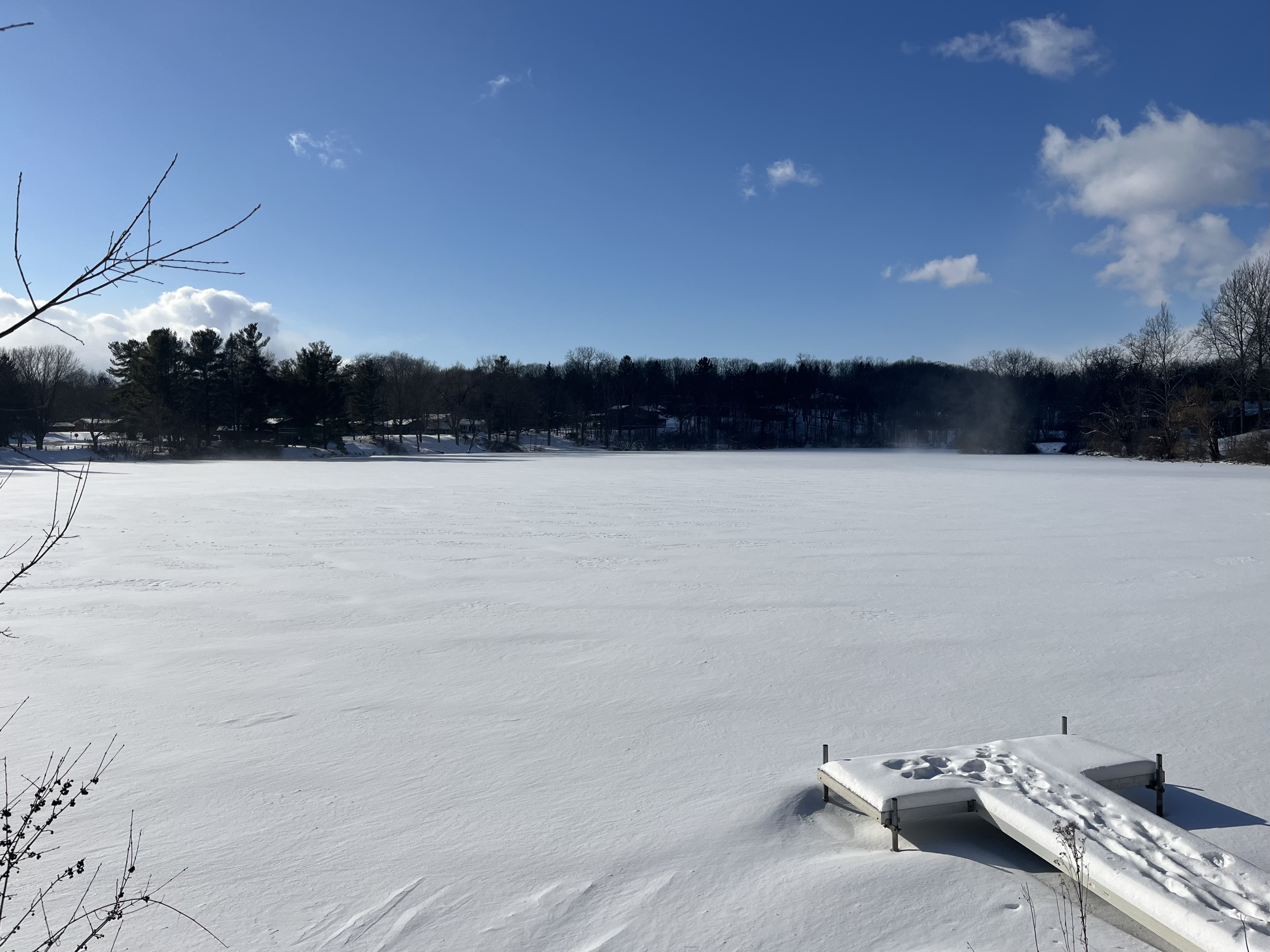
I took a loop around the lake, shedding my gloves and wishing I hadn’t worn a coat. This is when we Midwesterners start to get a little cocky—just a few ticks of the thermometer and you’ll start seeing T-shirts.
Having been shut down by COVID these last few days (both surprised and not that it’s still a thing), escaping my bedroom isolation was particularly jarring. There’s a surrealism to it, expanding one’s perspective so extremely and so quickly, not unlike the vertigo of emerging from a wooded path to a cliff’s edge. It’s exhilarating and an unexpected exercise in trust.
Is this okay? Everything looks safe, but am I?
I walked the perimeter, stopping to watch a group of parents and kids playing ice hockey in the section closest to our neighborhood park, a pair of folks ice fishing closer to the lake’s epicenter, feeling gratitude percolating in my gut.
Life goes on. This is what we’re here for.
The Dual State
I’ve been thinking a lot about Teddy Roosevelt recently. Not so much the man (whom I’ve always admired), but the mantra.
Specifically, a quote I picked up long ago from one of the several biographies in which I’m sure it’s included. It always seemed to sum up Roosevelt’s particular brand of indefatigable energy, his extreme discipline for action, and it hit me at an age when I needed to better understand my own appetite for effort.
“Get action. Do things; be sane; don’t fritter away your time; create, act, take a place wherever you are and be somebody; get action.”
Over time, I’ve interpreted these words to the point of reinvention. Over decades, the voice has become my own, varying in intensity as the situation demands:
Get action. Stay sane.
These last weeks—which we all feel very certain ways about—have electrified these words with a new flavor of energy. It’s not invigorating or encouraging, to say the least. It’s not even mildly optimistic. There’s no self-parenting here, no pep-talk vibes.
It’s a mandate. Do this, OR ELSE.
I bring this up partly to dissect for myself, via this newsletter—as I’m wont to do—but also to insert, somewhat delicately, into the collective debate we’re all having with ourselves and each other.
Naturally, we’re struggling to understand how to do the right thing when everything is going so wrong.
What even is the right thing?
Do I protest (enough)? Should I send money to this group, stop giving money to that business? Move to Sweden? Become a prepper? Buy a goddamn gun?
And all the while, life goes on around us. We’re both blessed and cursed by the normalcies that appear immune to all accumulating crises.
We find safety in our routines, personal and collective, but we also want, in some ways, for our world to be less ordinary—for it to rise to the occasion with our senses and our emotions, for it to match the emergency and, in doing so, validate our experience of it.
We’re both excited and repulsed by another Super Bowl proceeding as scheduled. We’re stoked about Bad Bunny, and also… how dare he. We won’t watch, but we crave the freedom to do so.
This aligns with what David French recently described in a recent New York Times op-ed as “the dual state.” Borrowing from Nazi-era Jewish labor lawyer Ernst Fraenkel, French was giving historical context to what currently feels like an out-of-body conundrum for most of us.
We’re going to work, making our kids’ lunches, watching families enjoy the weather and each other, readying our taxes.
And
We’re calling off work in protest of our own government, our kids’ lunches cost double what they did last year, we’re watching families gutted by inhumanity and violence—fuck paying taxes.
French explains it this way:
The two components of the dual state are the normative state—the seemingly normal world that you and I inhabit, where the “ordinary legal system of rules, procedures and precedents” applies—and the prerogative state, which is marked (in Fraenkel’s words) by “unlimited arbitrariness and violence unchecked by any legal guarantees.”
Beyond the obvious dangers perpetrated by those operating in the prerogative state, there’s an equally insidious peril lurking within the normative state—that being the illusion that more sensible minds and actions will prevail.
It’s the continued existence of the normative state that lulls a population to sleep. It makes you discount the warnings of others. Surely, you say to yourself, things aren’t that bad. My life is pretty much what it was.
We’re designed to rely on this perception of safety, and at the same time, to be attentive to existing and/or potential threats. We somehow, though, as the complex creatures we are, manage to talk ourselves both out of and into danger almost simultaneously. It’s ad hoc choreography. It’s survival.
We see the peril—these days, often witnessing it with our own eyes—and yet at some point have to negotiate ourselves into a state of stasis, lest we lose our fucking minds.
The larger point David French is making, through the comparative (but not predictive) lessons of history, is that the normative state ultimately becomes servile to the prerogative state, feeding its growth and strength.
The survival of the predator is based completely on its ability to manipulate and capitalize on the defenses of its prey. It’s everywhere in nature, external to the human experience just as it is internal to our own bodies.
Cancer and fascism are close cousins.
Exceptionalism Is Earned
We feel powerless, yet pressed hard to do something. Anything—and also the thing.
We’re predisposed, in this era of immediate gratification and runaway confirmation bias, to want our actions to have instant and recognizable effect.
We’ve been conditioned to accept being both hyper-vigilant and sensorily overwhelmed, doing what we must while also feeling like it’s not even close to enough.
What worries me most, what incenses me most, is how our vanity—both as Americans and as collective victims of late-stage capitalism—is keeping many of us from doing those “right things.”
Vanity as in egoism. Unique and unequaled. Never before and never again.
Right as in virtuous. Of and for morality. Humane for all, and for always.
It’s never been more dangerous to think that any of what we’re experiencing is new and thus novel. That our problems have no precedent and so bear no apparent solution. This is exactly what the prerogative state thrives on, along with the expectation that there’s a line somewhere that couldn’t possibly be crossed, that the heinousness of it all is less real than reality.
But this has all happened before. Countless times and over the course of centuries. We can revisit history for instruction and perspective, and we can also—must also—contribute to our own.
What Makes Us Human Will Also Make Us Better
We can’t despair our way out of this. There is only action—vital and real and effective.
Action looks different for every individual, as it should. The activities we choose, the ways in which we make intention real, are most powerful when they’re sticky with our values and gifts.
If, however, anyone reading this thinks that the size of their actions doesn’t meet the size of the moment, please—and I write this with the purest compassion—get over yourself.
We can’t be lulled into submission as global citizens for the same reason we wish we had more views on our last TikTok. Because we want to be that significant, but just can’t compete.
Democracy is conceptual, made practical by shared laws and moral agreements. Experimental yet—and when or if it fails—we’ll be left with what we started from: our shared humanity.
The actions we take now, not purely in reaction to the inhumane, contribute to what comes next. It’s beyond protest, how you vote, where you buy your toilet paper.
The actions we take need to be fueled by what is more essential to us than our fear. While emotion can be cajoled into motivation, the things that make us human are also the things that will save our humanity.
Empathy
Creativity
Curiosity
Belonging
Resilience
Purpose
Imagine what life would be like if every person on the planet acted—with intention—on just one of these, every day and in any way.
Now stop thinking about it.
Get action. DO things.
You’re built for this.
 Bree Stilwell