What gets removed, what stays behind, and what grows in its place
Friday, June 27
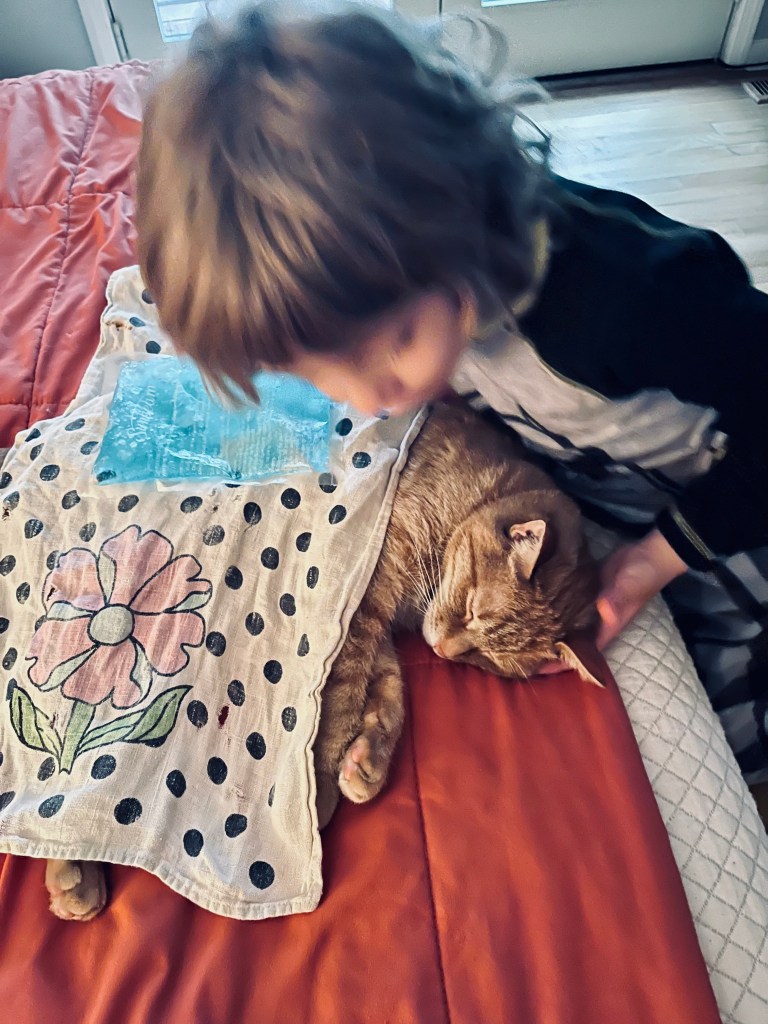
He’s snoring next to me, the kid.
But… miracles!… it’s a very different snore than it was just six hours ago, thanks to this morning’s intracapsular tonsillectomy and adenoidectomy.
‘The size of walnuts,’ the surgeon said, making a walnut-sized ring with his pointer finger and thumb. ‘The tonsils,’ he clarified, not the adenoids. But apparently those were ‘impressive’ as well.
The post-surgical relief makes writing to you a bit easier, and I’m feeling as snug as a bug in a Instant Pot, cuddled up with this gurgling hotbox of a boy, in 80-something. degrees plus equivalent humidity. Nothing could tear me away, though the sweat might force me out of the bed like a boulder in a mudslide.
We’ve waited a year for this day. Not because tonsillectomies are in greater demand, supplies stuck outside the Port of Los Angeles because our local hospital can’t afford the tariffs, but because, well… life timing, I guess.
So, here he is, sounding more like a hibernating animal and less like a drowning one. And here I am, marveling at how a surgical procedure (albeit a routine one, these days) took less time than the ‘follow-up’ with my oncologist last month, and more than a little horrified that a piece of my boy was medically incinerated at some point in the last 24 hours.
I would’ve preferred them in a jar, no question. I mean, why don’t we keep our amputated body parts anymore?
I’d put them, along with those adenoids, right next to my own surgically removed breasts, maybe even at my writing desk so the sun backlights the trio of them dramatically and at all hours… three bears… trophies of trials endured in XS, S & M.
I suspect it may be my abysmal lying skills, but I’ve never been at all adept at sugar-coating. When asked if something will hurt, the answer is always ‘yes, and…’ If it will be hard, sad, stressful, long, boring, every time the same lede.
It’s so prototypical at this point that my boys know they can give me the vaudeville hook when I’ve gone well beyond the gist, respectfully pulling the curtain on any more information.
They also know I’m a headliner. This stuff will inevitably come back around.
And so it went with the kid and his soon-to-be-biowaste tonsils. We talked about it for a decade, it seemed. It was four months in actuality, which in early parenting years pretty much is a decade.
I carefully unrolled the details over the course of those months, presenting them like hard-won clues to the most illusive of treasures. The strange and terrifying unknown that is anesthesia. The gas mask, IV and backless hospital gown (you get to walk backwards!). The meds, the tasteless, shapeless foods (if any at all) and the most extreme of challenges—no climbing, running or jumping for two whole weeks.

These tests and tribulations would ultimately lead to dazzlingly extravagant slumber, bigger mouthfuls of pizza (directly commensurate with more overall pizza and less hounding from his mama to just, pleeeeease eat!), and, the golden carrot for me, a boy able to more consistently focus his bohemian passions through the day without the constant drag of sleep deprivation.
Bribery of a sort, I suppose, but only insofar as the pain is included in the payoff.
We talked about how good it will feel to be on the other side of something scary and difficult, and about how excitement is fear’s identical twin. We talked about all the things we knew we could expect, and about how even those things could and often do change.
How is this not completely destabilizing to a seven year-old?
Or… to a fifty year-old??
Because fallibility. Because, as much as we yearn to be omniscient, to always deliver what we promise, to be able to assure without any possibility of inaccuracy, we’re actually human people. And humans, I for one, make mistakes all… the… time.
This might be the greatest gift I can give my kids, and like a new couch or a family vacation, it’s something I get to unwrap, unbox, and enjoy myself, undeniably more than they yet do. It’s something to sink into and find relief within. A luxurious break from the constant effort to do right.
Do it to the max or don’t do it at all.
Be everything or nothing. And while you’re at it, prove it. Give us all proof of your value, or lack of, so we can see ourselves seeing you.
We don’t need therapy (and GAWD, we absolutely don’t need this much therapy!) to change our fantastically delusional ways, we just need to stop inhaling—-the insistence to have it all figured out is the air we collectively breathe.
It’s tremendously difficult to avoid even the lure of ‘knowing’ these days, the goal of which isn’t necessarily to realize a thing, or to even commit it to knowledge, but to be comforted by a general reassurance that the thing, the feeling, heavens—the product—is real.
We’ve become so reliant on this abundance of validation, this acknowledging the authenticity of our every whim, let alone the wants that only feel like needs, that it now actually IS a form of safety. A constant but completely untenable state of confirmation bias.
The alternative isn’t ignorance. It is, of course, not that simple.
One thread of the parachute though is woven from both preparedness and the acceptance of all that is outside of our control.
It’s a bit of stoicism, a premeditatio melorum for the Cognitive Age. It’s an awareness of both of the incredible autonomy we enjoy as human beings, while also a respect for nature’s dominance.
We don’t necessarily have to walk through our days rehearsing our every response to disaster, but there absolutely IS a power to be gained from understanding how closely we’re tethered to the dubiousness of life. How, no matter the steeling of our resolve and the setting of our intentions, shit goes awry. And often for no reason we can identify.
It’s one thing to think about how to move through the palpable discomfort of this, even to appreciate it. It’s another, completely different and arguably more difficult thing to talk about it. To examine it, turn it around in your hands, pass it back and forth with another human person.
And that bit about our current obsession with pathologizing every single less-than-advantageous thing about ourselves? I’d argue that talking to our therapists about it doesn’t quite do the job.
There’s a murky bias in the clinical conversation setting, one that promotes an acceptable imbalance between an expert and a non-expert that can often be just another form of validation addiction. Listening to a trained professional tell you that what’s wrong with you is both okay and solvable proffers the illusion that we’re fully capable of understanding what often can’t be, and shouldn’t be, understood.
What we really need to strengthen isn’t our willingness to admit what’s difficult for the purpose of preventing its reoccurrence. We need to fortify our acceptance of the difficulties themselves, to school ourselves on them and then watch them come and go from our lives.
We need to gather real-time data, over time and via heart and mind, to have any contextual understanding of resilience.
There were several moments during my repeated ‘surgery prep’ conversations with the kid when he told me he just didn’t want to talk about it anymore. I knew why, but still asked why.
‘Because this is an uncomfortable topic for me.’ he told me the last time through. (Ugh. I’m not sure I could say those words out loud until I was forty-seven.)
‘I bet it is, Bub. And it’s totally okay to be uncomfortable.’
Our lizard parent brains beg us to tell our kids (and ourselves) something very different. That it’s going to be okay, that there’s nothing to be scared of and that they (we) won’t feel a thing.
What this particular exchange allowed for though was a tweak toward another destination, a way toward a reality that includes discomfort, pain, fear and even loss. Those same obstacles we all need to be able to find our way over or around versus stopping well short of.
When we talk about it amongst ourselves, from one blindfolded, fumbling human to another, we’re doing so in a way that translates something like, ‘I’ll get us through the desert, but then it’ll be your turn to drive us over the mountains.’
We’re together, well aware of our collective peril, but there’s really only one driver’s seat.
Thursday, July 3
Tomorrow marks a week post-op, and with it, the perspective of a journey made and a person changed.
His breath smells like he’s been eating rotten flesh, but he’s taking, and swallowing, bigger bites. He’s alternated regularly between cranky and content, spending more time in the latter state as the hours tick by.
His voice is different, pitched higher—ironically making him sound younger than this now slightly wiser boy feels.
‘Are you so proud of how brave I was, Mama?’
‘Absolutely. SO proud. I’m maybe even more proud of how scared you were. How you felt really scared and then you just kept going.’
‘Yeah. I did.’
He smiles, his resilience stronger than his body is lighter.
 Bree Stilwell